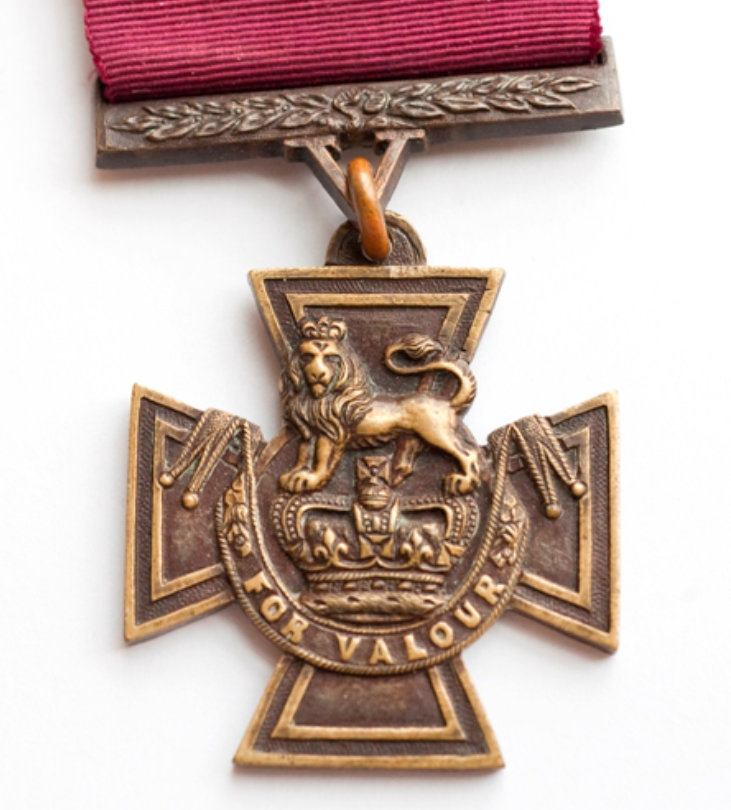
On 26 September 1915, the 9th Battalion were in support of an advance of the Cameron Highlanders. As the situation deteriorated, and Saunders found he had no officer left and quickly took over command of the Platoon. His citation reads:
‘For most conspicuous bravery. When his officer had been wounded in the attack he took charge of two machine-guns and a few men, and, although severely wounded in the thigh, closely followed the last four charges of another battalion, and rendered every possible support. Later, when the remains of the battalion which he had been supporting had been forced to retire, he stuck to one of his guns, continued to give clear orders, and by continuous firing did his best to cover the retirement.’
He was recovered by stretcher bearers from the Scots Guards. Common belief states that the wounds to his leg meant that it was amputated when he reached an Advanced Dressing Station. However this is inaccurate. After medical attention and a period of convalescence his leg had become three inches shorter. He wore a medical boot to aid his walking and on his discharge from hospital he returned home to a civic reception in Ipswich. The townspeople and Croydon's, a local jewellers, collected a sum of £350 for him in grateful recognition of his deeds.
He and his wife wisely used the money to buy the house that they would live in for many years to come. He returned to Ransomes and rose to become Works foreman. During the Second World War he became a Company Sergeant Major in the 11th Battalion (Ipswich) Home Guard. He died in 1947. He was the first Suffolk Regiment soldier to be awarded the Victoria Cross.


"For most conspicuous bravery. Corporal Day was in command of a bombing section detailed to clear a maze of trenches still held by the enemy; this he did, killing two machine gunners and taking four prisoners.
On reaching a point where the trench had been levelled, he went alone and bombed his way through to the left in order to gain touch with the neighbouring troops. Immediately on his return to his section a stick bomb fell into a trench occupied by two officers (one badly wounded) and three other ranks. Corporal Day seized the bomb and threw it over the trench, where it immediately exploded.
This prompt action saved the lives of those in the trench. He afterwards completed the clearing of the trench and established himself in an advanced position, remained for sixty-six hours at his post, which came under intense hostile shell, grenade, and rifle fire.
Throughout the whole operations his conduct was an inspiration to all."
Sidney Day was invested with his Victoria Cross by King George V at Buckingham Palace on the 9th January 1918. He died on the 17th July 1959 in Portsmouth and was buried in the town's Milton Cemetery.